
Abra Berens: Hosting a Dinner Party
The purpose of this packet is to help take some of the ideas talked about throughout Chicago Humanities Festival and move them into the domestic space via dinner parties as conversation salons, because listening to a lecture is learning but exploring those ideas with others is edification. Thinking about how to help lay the setting for conversation has distilled some key elements of hosting, revealed how to do so deliberately, and produced a couple tools to encourage and support others to do so.
First and foremost, consider why you want to host. What is at the heart of the gathering that affects not only how you lay the scene but also how the gathering will feel to you (and hopefully to others)? This is not a manual for gathering out of obligation. It is a handy tool kit to aid your role as a host who is truly at ease and that uses food as a vehicle for talking about the big and little things of life, as you want to.
After you’ve decided why, the most important thing is the care with which you hold your guests. This is sometimes offhandedly referred to as cooking with love. I don’t love everyone I host, but at least for that night, I care for them. Thinking about what they need to feel at ease is one of the most caring things out there.
Confidence and vulnerability are inextricable from great hosting. I came to this understanding from something my husband, Erik, says about weddings: the energy of the couple determines the experience of the guests. Weddings are hard. The couple is on display, and there are a lot of “cooks in the kitchen”. That can be insecurity-inducing. The best weddings, and gatherings of any sort, are when the grace of the host multiplies with the enthusiasm of their guests. Do whatever it takes to be truly, coolly confident, and for me that often means inviting some vulnerability.
Remember that too many sequins can ruin the dress, aka Less is More. Think about what you want to provide and then take two things off. Don’t let the appetizer hour steal the food show, because that is when people are still siloed. Get them loose, and then bring them together.
Be prepared to spur or shift conversation. Think about what you want to know or ask each person attending, and why. Ask and then allow the work of creating a space for the exchange of ideas to blossom without too much tending, even if it can be a bit nerve wracking to have created a space for intense conversation.
Ultimately, I believe that the table is where much of our culture is developed. Creating that setting has little to do with the food and nothing to do knowing where Ms. Manners would put the fork. I hope that these ideas, with recipes as support, make it easier for you to build an even better society one conversation at a time in the comfort of your own home.
Hosting with Care
I’ve heard countless times that something is delicious because it was “cooked with love”. I find this irrationally annoying. Maybe it is because it is sappy or cute, somehow less than the incredibly powerful act of real care. Of dedicating some of your most valuable resource– attention– to those for whom you are cooking.
Over the years, baklava has become the thing I make to end a dinner party for a couple of reasons. One, at the luxurious conclusion of a long, conversation-filled night, a big cake seems to distract, or at least redirect attention back to the host. Can you imagine anything more embarrassing than wanting everyone shaken out of their conversation to think about you? Yuck. The answer: a snacky dessert. I put out a platter of baklava, some chocolate bars that folks need to break for themselves (to add to the familiarity already built throughout the night), and some fruit. Enough other things to supplement if someone isn’t eating gluten or nuts. Allow folks to linger but not be fussed over.
The other reason for baklava is that it is kind of a pain to make and it takes care—the exact feeling I want my guests to be wrapped in throughout their visit. Each layer of phyllo needs to be laid out gently to prevent tearing, brushed delicately with fat (I mostly use olive oil) all the way to the edges, and then the next sheet laid on top with precision. I pull a sheet for each person in attendance and think deeply about each individual as I brush the olive oil over their sheet. What questions do I want to ask them? What do I know of their life right now? Who am I excited for them to meet?
There is also something poetic about the first thing I make for a party being dedicated to each person coming, and then concluding the night with those thoughts and care being presented to them as a final act of generosity.
Baklava is also best made ahead, and so you can give that care and attention before the hubbub of the event itself. So, a success logistically, emotionally, and poetically. No small feat.
Care-filled Baklava
- 1 sheet of phyllo pastry per person attending (or minimum 6)
- olive oil
- 1 ½ cup pistachios, walnuts, and almonds (any proportion is aok)
- 1 lemon zest
- 1 tsp 5 spice or cinnamon
- ½ tsp salt
- ¼ cup plus 2 tbsp sugar
- ¼ cup honey
- Heat oven to 350F
- Toast the nuts until deeply browned and fragrant, about 10 minutes
- Allow the nuts to cool and then pulse in a food processor with the lemon zest, 5 spice, salt, 2 tbsp sugar, and 2 tbsp olive oil
- In a small sauce pan, heat the ¼ cup of sugar and honey with ½ cup water to make a light syrup
- Allow the syrup to cool and then add a glug or two of olive oil to it
- Lay out the first sheet of phyllo and brush with olive oil all the way to the edges
- Repeat with the next sheet of phyllo
- Spread a ½ cup of the nut mixture in thin line along the long length of the phyllo layers leaving about two inches from the bottom
- Brush all exposed edges of phyllo with more olive oil
- Roll the two inch border over the nut mixture and roll all the way to the top making a thin log
- Repeat with the remaining phyllo layers and nut mixture
- Transfer the three logs to a baking sheet or oven proof dish and cut into 2 inch long pieces
- Bake until golden brown and caramelized about 35 minutes
- Remove from the oven and immediately pour the honey syrup all over and finish with a sprinkle of salt
- Let the baklava rest until dessert—it stores at room temperature for about a week
Confidence
The most valuable energy a host can convey is one of confidence. True confidence manifests for me as ease—you are at ease with yourself, your space, why you are gathering people in the first place. A dinner party plagued with catastrophes but helmed by a confident host is infinitely more enjoyable than a picture-perfect event lead by someone who is constantly apologizing or merely cooking at rather than for their guests. Sadly, too often, feigned arrogance or casualness is used to attempt to fill the void where confidence could be.
It can be hard to find confidence, but it is possible to cultivate it. For me, I rely on a couple of exercises to help give it an edge over my own innate insecurities.
One, think about who is coming and why. What am I scared that they would think negatively about, and do I actually care? Usually pausing to think about what the worst-case scenario could be reveals it to be a phantom haunting only your mind. If you legitimately think the people you’ve invited to your space will be secretly making a list of your deficiencies, cancel that party! Call your real friends. Host a group that recharges you, and only then consider hosting folks you don’t love as much because you will have the confidence of your community at your back. Sometimes you must have folks you don’t care for or don’t trust at your events, but you should be able to wear the confidence of your people as a shield against their bad energy.
Two, make something that you love and can make in your sleep to serve. I like having one dish that is challenging for me and for the rest I rely on old standbys that deliver endlessly. I used to be afraid that my friends would think, “ugh, chicken over bread again,” which is when I realized that friends who would think that are not friends (and in reality, many said it was something they hoped would be served). We all like consistency, and this can be a sly way to achieve that. If you don’t have that dish in your repertoire, I’ve included mine below.
Three, fake it til you make it: the annoying adage that is also true. While you are making the thing that makes you feel confident, go through the sometimes-silly steps of encouraging that confidence to blossom. Put on the pair of shoes you feel best in while cooking or cleaning for the party. Put on the scent or lipstick that makes you feel good. Play the song that makes you bubble up and play it a couple of notches louder than you normally would. All these little things provide fertile ground for confidence to grow.
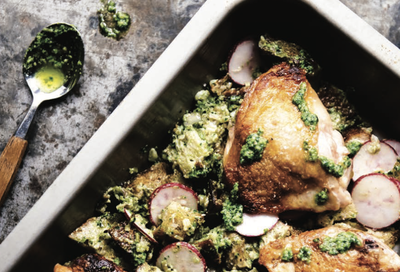
Chicken Over Bread
This is one of my favorite things in the world because it is endlessly surprising for people and endlessly adaptable to any time of year. It can also be made vegetarian by substituting the chicken for a showstopper vegetable that can take longer cooking; things like squash wedges, thick mushrooms, or big pieces of cauliflower have worked for me in the past. If making vegetarian, I also often add some chickpeas or firm tofu to the base for extra protein. If you need a gluten free option, potatoes or other root vegetables fill in nicely.
Notes:
I keep a random bag of cubed bread ends and old bread in my freezer to make this dish which gives second life to the last of a loaf.
This can be made a few days in advance and held in the fridge until the day of your party. No need to bring it to room temp just pop it into the oven.
If using potatoes, use 1 cup of stock because they don’t absorb liquid in the same way
- 8 bone in, skin on chicken thighs (you can use a whole chicken spatchcocked or pieces too)
- 3-4 cups cubed bread
- 1 onion, sliced thinly
- 4 cloves garlic, roughly chopped
- ¾ cup something acidic, cherry tomatoes, pickles, sauerkraut, kimchi
- 1 lemon, cut into quarters and seeds removed then cut into ½ inch thick pieces
- 1 cup dry white wine or ¼ cup vinegar diluted into water
- 1 ½ cup stock or water
- Heat oven to 400F
- In a large oven proof frying pan, heat a glug of oil over medium heat
- Pat the chicken thighs dry and then season liberally with salt and pepper
- Sear, skin side down until the skin is golden brown then remove from the pan
- Add the bread, onion, garlic, acidic item, and lemon and toss all around
- Add the wine and the stock then lay the thighs skin side up on top of the bread
- Return to medium heat and bring the liquid to a boil (just a couple of bubbles is fine)
- Remove from the heat and transfer to the oven to bake until the chicken is cooked through, about 35 minutes
- The liquid should be mostly absorbed and the chicken cooked through with crunchy bits of bread and soggy bits of bread—if there is still a lot of liquid return to the burner and simmer until reduced
Vulnerability
I believe that confidence and vulnerability are two sides of the same coin. When I am confident, I have an easier time being vulnerable. When I allow myself to be vulnerable, it seems to open a door for others to know me better and deepen our ties.
I like to make one thing for a party that makes me feel a bit vulnerable. That can be a new recipe or something that I love that is sort of weird and will catch people off guard in a way that might make me feel nervous in the moment. I find that this, more than anything else I do, spurs conversation, which is after all the point.
One dish that does this is Pickle Soup, a very delicious starter that sounds like the premise for a children’s book. I make it because I love it, because it is good hot or cold (so not season-dependent), and because I grew up on a pickle farm, which inexplicably seems to make people laugh. Through this soup I can talk about what it means to grow pickles (the cucumbers not the jars), how my grandfather dropped out of the 8th grade to farm and was functioningly illiterate but could calculate per-acre yield faster than anyone and without pen or paper, how my father—under the watchful eye of my grandmother, the first female school principle in our district— was the first in his family to go to college let alone medical school, how my dad (and newlywed wife, my mom) moved back to work the farm when the farm struggled in the transition from migrant field labor to mechanical labor, how we didn’t really eat that many pickles because it was a commodity farm but pickles feel like a part of my identity nonetheless, how the recipe is not a family tradition but an adaptation of sauerkraut soup taught to me by Chef Paul Virant who was taught to make it by Chef Jean Joho.
I don’t need to tell everyone all of that, but they are likely to ask about Pickle Soup and that is all a part of my story. That story easily rolls into contemporary topics like immigration, rural America, the role of education, the role of public schools, the role of agriculture and inherited wealth, the role of mentorship, why restaurants are obsessed with pickles these days, and on and on. Vulnerability is not blathering your life pain, but instead allowing people to know something about you that is deep and personal. I am a writer and come from a family that has illiteracy only one generation away. Pickle Soup tells that story. Allow yourself to tell yours and give them an opportunity to ask.
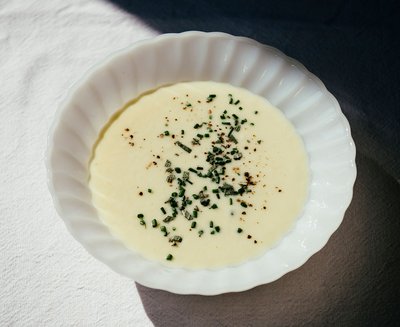
Pickle Soup
DO NOT MAKE THIS WITH BREAD AND BUTTER PICKLES!
- 1 onion, sliced thinly
- 2 cloves garlic, roughly chopped
- 1 cup chopped dill pickles
- 1 cup pickle juice
- 1 lb Yukon gold or similar potato, cut into chunks
- 4 cups stock or water
- ½ cup cream (optional)
- 3 sprigs dill or parsley, chopped
- In a soup pot, heat a knob of butter or big glug of olive oil over medium heat
- Add the onions and garlic with a big pinch of salt and sweat until soft but not browning
- Add the pickles and pickle juice and increase the heat to high and simmer until reduced by half
- Add the potatoes and stock, bring to a boil, reduce to a simmer and cook until the potatoes are tender
- Blend until silky smooth then whisk in the cream if using
- Taste and adjust the seasoning as desired
- Serve with a sprinkle of dill, grind of pepper, and glug of olive oil over the top
Note:
The danger in serving soup for a party is that folks get full, so plan on only 4 oz or so per person. With that portioning you will have leftovers from this recipe, which is a good thing.
Additionally, while soup is a bit of a risk for a party, it also helps the group transition to the table. Everyone loves to chat, and the expediency of soup can force them to sit down finally! To limit the stuffiness of a plated course at a party, I often serve this in a small mug and no spoon.
The Welcome
The Welcome to a party is important because it is often the most awkward time. Folks aren’t sure if they arrived too early or too late. They haven’t yet softened the rigidity of small talk or catch ups. I find the best thing to do, as with children, is to not jump in but let them navigate on their own, with good boundaries, and with something to do with their hands. In my house that’s a veggie board and one dip.
As of late, appetizer hours have grown and grown and run the risk of eclipsing the meal. I say less is more, and it should not cause you stress. Put out a dish of nuts or a bowl of olives or a hunk of cheese and whatever crackers you have around.
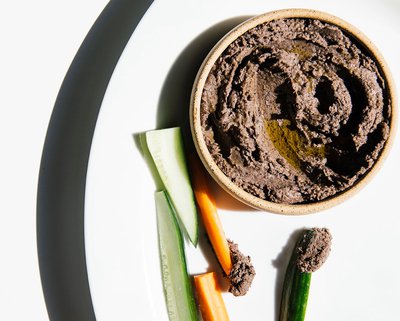
For me, I do love a veggie platter because I can cut everything a day or two in advance and serve it with whipped tahini, which I usually have on hand anyway. I never put out little plates because I want folks to be disarmed by using their fingers, but I do put out napkins to keep them from feeling crude or messy.
Less is more here. Which is also true of space. When possible, I like to start a party in a space that is maybe a bit too small to force folks to get to know one another. Don’t make everyone stand in a closet, but also don’t feel like you need to have a chair for everyone just yet.
Whipped Tahini
- 1 cup tahini
- ½ cup water
- Splash of vinegar or lemon
- Pinch of salt
- Put everything into a bowl and whisk together—it won’t look like it will work but it will come together
- You can thin with more water or thicken with more tahini
- Serve with any sort of vegetables, a mix or a pile of one type if that’s what you have
“What are you into right now?”
My very dear friend Ryan asks this question of folks often and it is nothing short of genius because it is specific and completely open-ended. Let’s face it, I’m into food and so I like to make something that I’m into and say just that. “I’m super into these XX right now. What are you into lately?” That can be a one-off conversation or the thing that you say when you introduce the meal, and yes, you have to introduce the meal.
When the soup cups are cleared or shoved to the side, I bring out platters of food—the Chicken over Bread still in the frying pan, a big green salad because I always make a green salad, and the thing I’m into, dressed very simply with a lemon parsley sauce.
It feels a little awkward to introduce the food because it feels like showing off or like you are forcing folks to feel like they need to say something nice out of obligataion. But your job as a host is to lead and to put your own comfort on the shelf occasionally in service to your guests. I usually say, “Ok here’s what we’ve got. Chicken over bread with this thing in it, green salad, and this XX which I’m super into right now. Thank you all for being here. I love cooking for folks because it makes space to BE with you all and hear what’s happening for you and what you are into right now.”
Then there is some hubbub of serving everyone and passing plates or platters, but after that dies down, you have laid the foundation for conversation. If you need to spur it on, ask someone what they are into and then just listen.
Lemon-Parsley Mojo with Whatever You are Into
You can add other things to this a bit of garlic or capers or anchovy. Then spoon it over whatever sounded good to you—sliced tomatoes and cucumbers, roasted carrots, thinly cut celery. Whatevs, just whatever you are into.
- 2 lemons, zest and juice
- 1 bunch parsley, finely chopped
- 1 cup olive oil
- Big pinch of salt
- Mix everything together and spoon liberally.
Note:
The lemon will eventually cause the parsley to oxidize and turn army green instead of bright green, it won’t hurt you but isn’t as visually vibrant, so I tend to not combine everything until 30 minutes or so ahead. You can chop the parsley and mix the lemon and olive oil days in advance and then just stir together in a flash.
Become a Member
Being a member of Chicago Humanities is especially meaningful during this unprecedented and challenging time. Your support keeps CHF alive as we adapt to our new digital format, and ensures our programming is free, accessible, and open to anyone online.
Make a Donation
Member and donor support drives 100% of our free digital programming. These inspiring and vital conversations are possible because of people like you. Thank you!