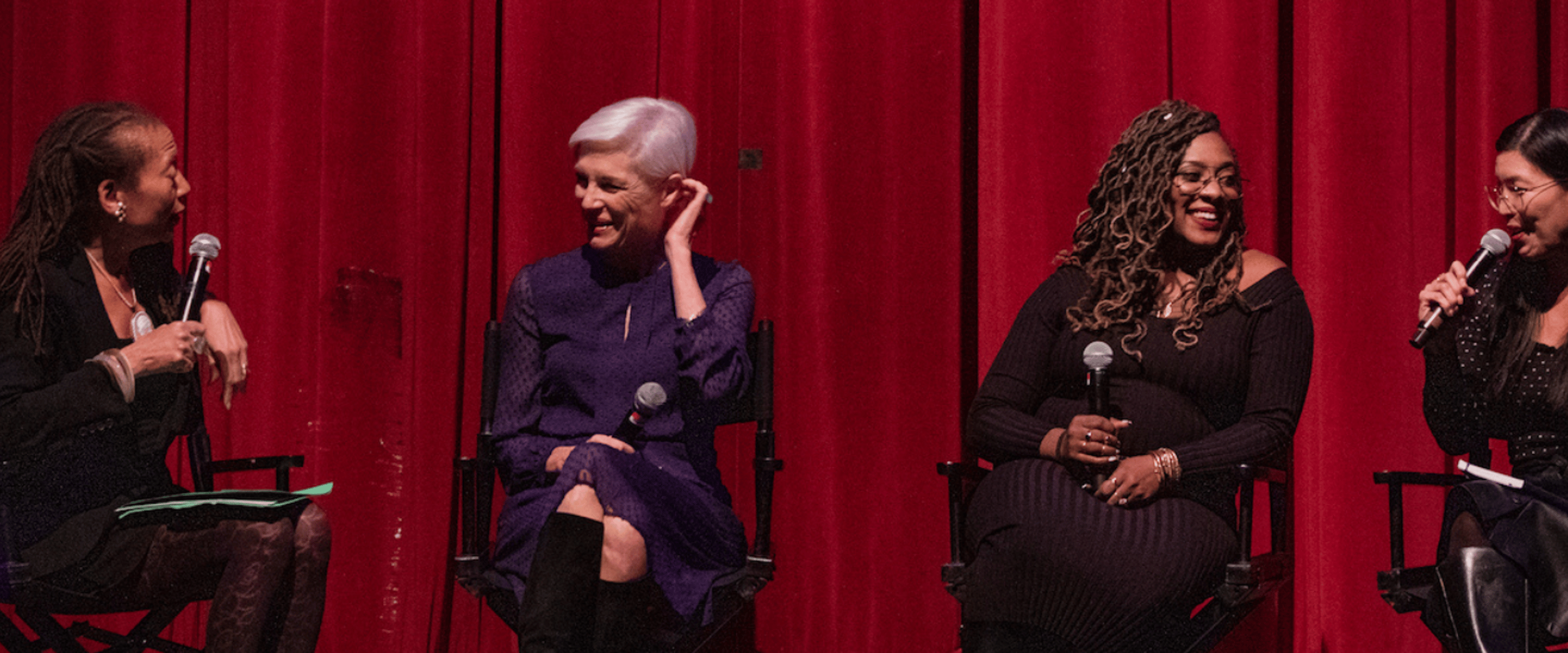
Our final week of the 2019 Fall Festival featured a number of powerful voices, such as Nikki Giovanni, David Sanger, Senator Sherrod Brown, Eli Saslow, and Mikki Kendall. This week’s programs gave us powerful ways to consider our past, address our present, and envision our future. To watch these programs and more, check out our video archive, featuring conversations from the Year of Power.
Our Powerful Past
This week’s presenters revealed new perspectives about our pasts, and urged us to consider how history can inform our present.
Photographer and Stanford professor Jonathan Calm is in the midst of an 18,000 mile road trip to capture all the locations listed in The Negro Motorist Green Book. Speaking at CHF, Calm discussed how enthusiastic the people he’s met along the way have been to share their personal histories: “People share their memories with me because they want them to be remembered, and then passed on.” Documenting this history can also feel painfully current, said Calm, given the number of people who have told him, “We need a Green Book for today.”
Historian Harold Holzer came to CHF to discuss the life and work of Daniel Chester French, the sculptor responsible for the Lincoln Memorial. An audience question about Confederate statues prompted Holzer to reflect on how public monuments—which, he says, “evoke intense emotional responses”—can help us confront and understand our past. As an example, Holzer discussed the statues of Supreme Court Justices Roger Taney (who delivered the Dred Scott opinion) and Thurgood Marshall that stand near one another in Annapolis, Maryland: “I think it’s so powerful to have these statues next to each other,” Holzer argued, because Marshall “not only gave lie to Taney’s assessment of people of color, but also became the first African American Supreme Court Justice.”
Richard Brookhiser turned to our founding documents in a talk about creating national unity. “America's concern with liberty,” is a common theme, he said, “something we have been working on for 400 years." Despite the chaos and conflict of today’s political climate, he urged us to not forget the importance of liberty: "This is what we have. This is what men and women have argued for, in many cases they have died for. And it's not self-perpetuating."
Ohio Senator Sherrod Brown was joined by his Pulitzer Prize-winner wife, columnist Connie Schultz, for a discussion on eight progressive senators who sat at Brown’s desk before him. Change may seem difficult, Brown said, but our history proves that it’s possible. Ultimately, Brown concluded, “I believe in the power of government to make people's lives better.”
Our Powerful Present
The week’s speakers had a few solutions for making our world a happier, healthier and more equitable place; ideas ranged from poetry to photography to political change.
“In order to get at what’s holding us down in the world, we have to have difficult conversations,” said poet Reginald Dwayne Betts. These conversations can happen verbally, said the Felon author, but he also encouraged his audience to consider poetry as a means of expression: “poems are supposed to make you look closer. The value of poetry is to force us to look closer and see things we wouldn’t otherwise see.”
Mikki Kendall agreed that conversations are essential. “We keep saying that racism will die out, that all the -isms will die out,” she said, “but they don’t, because they’re taught. If I can do just a little bit to unteach those things, then I’ve left the mark that I want to leave on the world.”
Ari Seth Cohen, who documents the stylish lives of the over-sixty set, revealed his reasons for writing his new book Advanced Love, a depiction of older couples: “Love is something that’s very healing for all of us. I wanted people to see the various experience of love in all ages.”
Photographer Emmet Gowin reiterated the importance of visual representation. Gowin, who presented his photographs of former nuclear test sites in Nevada, put it this way: “Treasure what you do have. A photograph captures an ephemeral moment and sometimes when you go to take a better shot, the subject is gone.”
Washington Post reporter and Rising Out of Hatred author Eli Saslow discussed the role the media has to play in combating prejudice: “It’s our job, as journalists, to tie the innuendo and dog whistles to their very real, racist history.” This work isn’t just for journalists, though: “Our work,” Saslow said, “is to confront the insidious, racist ideas that are around us all the time.”
Our Powerful Future
This week’s speakers offered visions of our future, from an increase in clean energy to the revitalization of affordable housing.
New York Times national security correspondent David Sanger warned us that there is no quick way to end cyber warfare: “Like terrorism or climate change, this is a problem we'll have to manage for decades.” His biggest fears for the near future? Ransomware attacks in voter registration systems, directed cyber attacks, and fake news stories to make people think there's election fraud.
During the panel on nuclear power, MIT professor Kate Brown encouraged us to view energy technology as a powerful source for social change. Speaking on the benefits of increased renewable energy, Brown said: “We can change our system, and we can lead with technology. One way to lead a revolution that isn’t violent is to change our technology, and that’s a hopeful, optimistic story.”
Architect Daniel Parolek presented his case for more “missing middle” housing — think duplexes, courtyard bungalows, etc. This concept, Parolek says, “encourages people to think big and...build small. This kind of thinking can lead to urban revitalization, and “can be implemented in Chicago to begin a powerful housing affordability movement.”
In between moving (and hilarious) meditations on America’s past and present, legendary poet Nikki Giovanni painted a futuristic take on Black women’s power: “The only people who can go into space are Black women,” Giovanni said, “because we are the only ones who can get along with every damn thing!”
Become a Member
Being a member of Chicago Humanities is especially meaningful during this unprecedented and challenging time. Your support keeps CHF alive as we adapt to our new digital format, and ensures our programming is free, accessible, and open to anyone online.
Make a Donation
Member and donor support drives 100% of our free digital programming. These inspiring and vital conversations are possible because of people like you. Thank you!