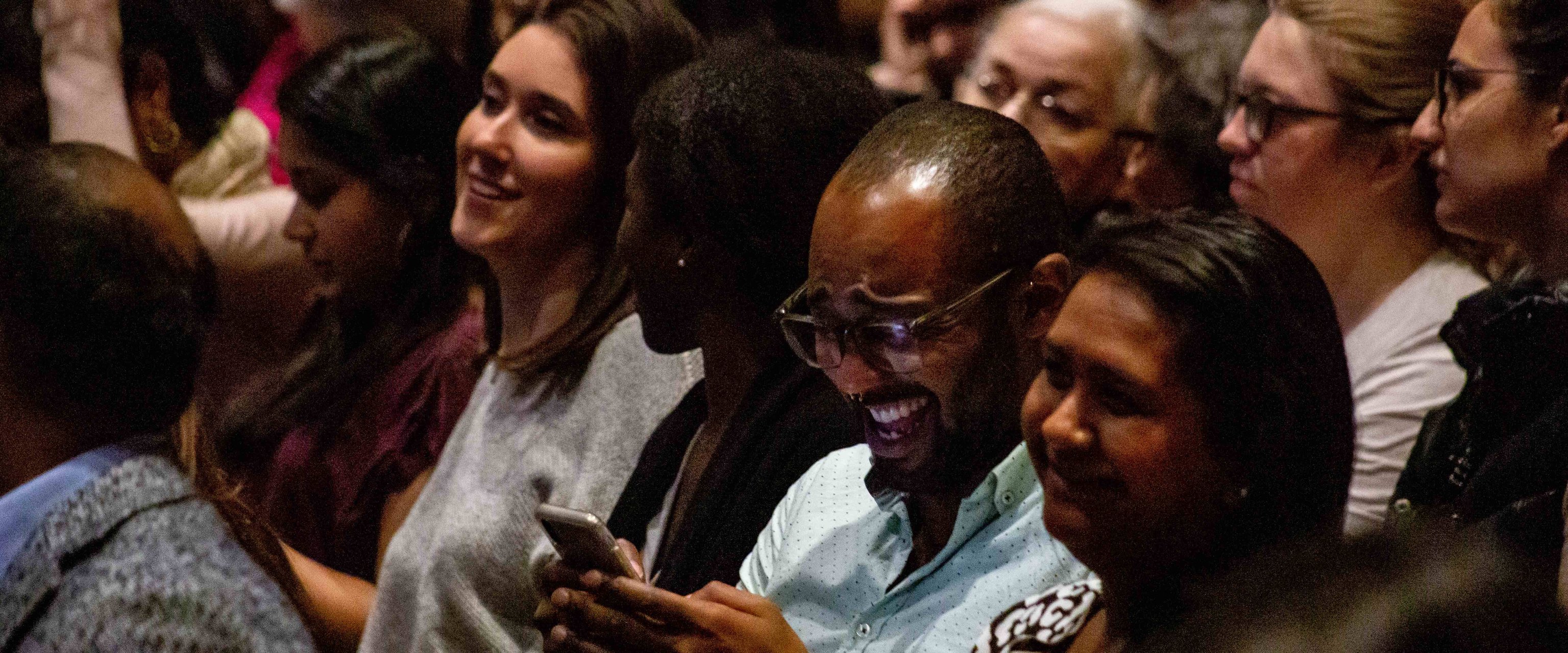
Over the past seven days, festival-goers have marveled at circles, colors, and cyberpunk women web designers of the 90s; celebrated libraries; connected the Greek myth of Talos to the Incredible Hulk; dished about dating with Phoebe Robinson (it’s trash everywhere); analyzed Hannah Arendt’s 1939 library card; and paid homage to both the typewriter and the Preamble to the US Constitution with the one and only Tom Hanks.
Here are some of the big takeaways from the past week.
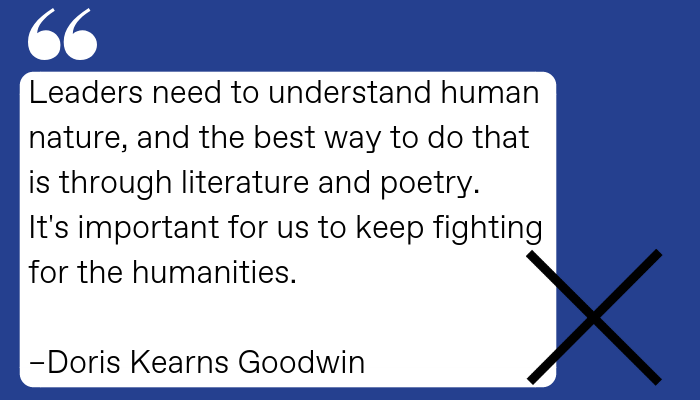
1) Despite our differences, we must still talk–and maybe more importantly, listen–to one another.
Kwame Anthony Appiah, speaking about identity categories and tribalism: “We are more tribal about political identities now, because our other identities are so destabilized. One thing you can do in the privacy of your own heart: Stop demonizing 'everyone else.'”
Later, Appiah gave some advice: “Our social worlds are very separated, it's not a good thing. We need to talk to each other. You can still be friends with someone who has bad politics. I hope we can still talk to one another.”
Francis Fukuyama posited: “The single greatest threat to democracy in the US is polarization.”
Later Martha Nussbaum echoed the calls to listen to one another in order to have a healthy society: “In a democracy we must look each other in the eyes and connect as equals.”
Doris Kearns Goodwin explained that Teddy Roosevelt “learned through conversation," and he also warned us that “democracy would flounder when people in different regions or parties saw each other as ‘the other,’ rather than as common American citizens.”
When asked how to use humor to address serious issues about race, Phoebe Robinson advised that humor can be a secret weapon to “disarm someone, and tell your own personal stories.”
Jeanne Gang talking with Eric Klinenberg about social infrastructure, got back to basics: “We’re human beings! We need shelters. We need places to interact.”
Titus Kaphar wants to see different kinds of conversations with artists: “We need to be talking to artists about ways to rethink the public square.”
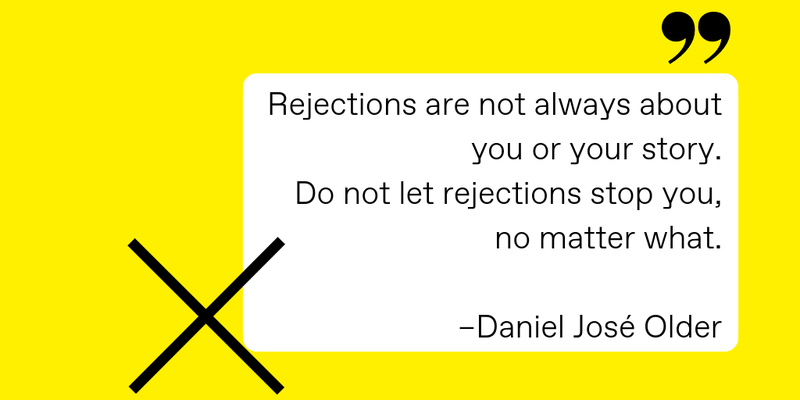
2) Success might come, ultimately, from resilience in the face of struggle.
Phoebe Robinson confessed her struggles with debt and massive student loans, even after “making it” with a top podcast and steady writing gigs: "While Jess and I had the number one podcast worldwide [Two Dope Queens], I was horrifically broke."
In a panel on Ida B. Wells, Eve Ewing reflected on the trials of Black women who speak out: "As long as there are people dedicated to being courageous, there will be people dedicated to silencing them."
Abbi Jacobson confessed that she went through a horrifically difficult breakup with the first person she’d loved, and that's partially why she hit the road solo for some inner reflection, ultimately producing her vulnerable book of essays, I Might Regret This.
Daniel José Older told an audience full of CPS students that his book Shadowshaper got rejected 39 times before it was finally published, and reflected honestly on racism in the publishing industry: “[Publishers] said people don’t wanna read about a Black girl from Brooklyn doing magic...we already have a Latino story this year.”
Daniel Barenboim: "Anytime you do something worthwhile in life, you are also bound to be criticized."
Kazim Ali: “I grew up with an understanding of the power of the feminine. But I also saw a lot of suppressed rage in the women of my family at the social constructs of gender.”
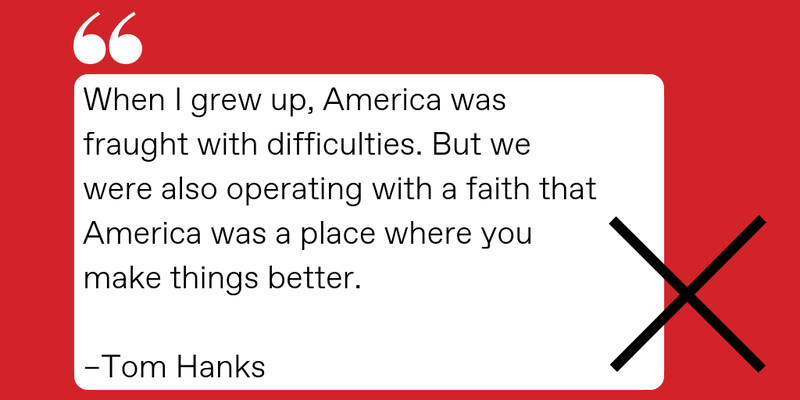
3) Voting is an important–but by no means the only–act of civic engagement.
Many presenters reminded audiences to vote in the midterm elections, including Tom Hanks, who said: “We have this amazing thing which guarantees us to have the leaders we want or the leaders we deserve. They're called elections.”
But Carol Anderson cautioned that voter suppression is a real threat to democracy: “Gutting the Voting Rights Act has taken the United States back to the 1950s.”
And Donna Cox drew attention to gerrymandering, as “a great example of data being socially and politically maneuvered.”
Furthermore, Francis Fukuyama encouraged audiences to be mindful of the big picture beyond elections: “A liberal democracy is not just about elections. It's about institutions, and checks and balances so there are limitations on power.”
And Doris Kearns Goodwin reflected on our present moment: “It's not just a blip that so many women are running right now. The framers created checks and balances, but the ultimate check is the American people. What we need to do now as citizens is hard, hard work.”
Eve Ewing gave advice to young people of color in the audience to continue the legacy of Ida B. Wells: “This is the city of Ida B. Wells. This is the city of Gwendolyn Brooks. This is the city of Natalie Moore. Your story can and should be heard.”
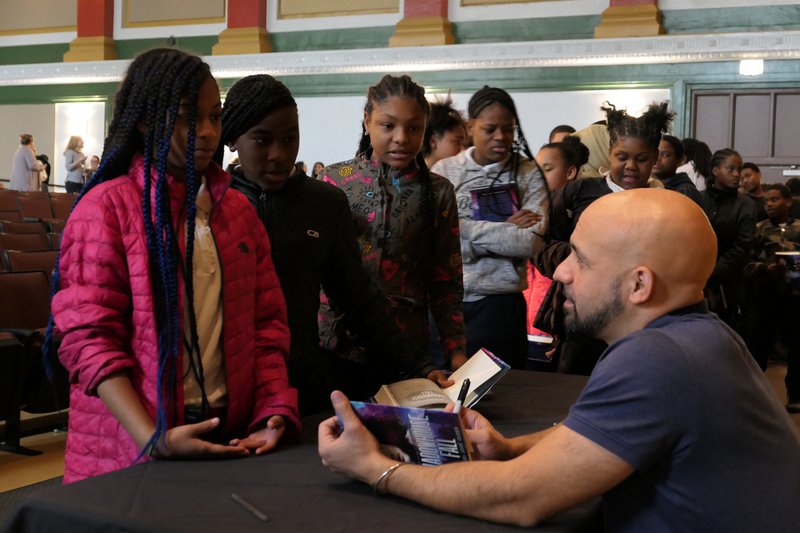
Daniel José Older signs copies of his new book for CPS students at CHF's Student Matinee.
Asides, Observations, & Miscellany
- Around 900 students from all around Chicago attended Monday morning’s Student Matinée with author Daniel José Older, and each of them received their own copy of Shadowhouse Falls. After picking up her new book, one student took a deep inhale and said quietly, “I love that smell!” (Us too, young reader, us too).
- Doris Kearns Goodwin stated confidently, “Of course we'll have a woman president, of course. We're so behind!”
- Phoebe Robinson played a very special voicemail through the mic at Thalia Hall, and divulged that hugging Oprah felt like “Black History month, as if it never ended." Also, according to her, you’re seriously adulting if you can finish a bag of baby carrots “before they turn ashy.”
- David Grann: “Everybody has their own Antarctica, a place where they go to find themselves.”
- On the difficulty of writing a memoir, Kiese Laymon confided: “My mom went to graduate school. She’s an educator. She loves books. The written word is our currency. But we weren’t supposed to use them in ways that could expose family secrets.”
- Abbi Jacobson: “I love a good theme!" Sam Irby: "...Graphics, amiright?"
- Kazim Ali: “There are many different ways to think about the role of a writer in politics. But if you absolutely think that your work has nothing to do with politics, then you’ve chosen the wrong side. That’s complicity.”
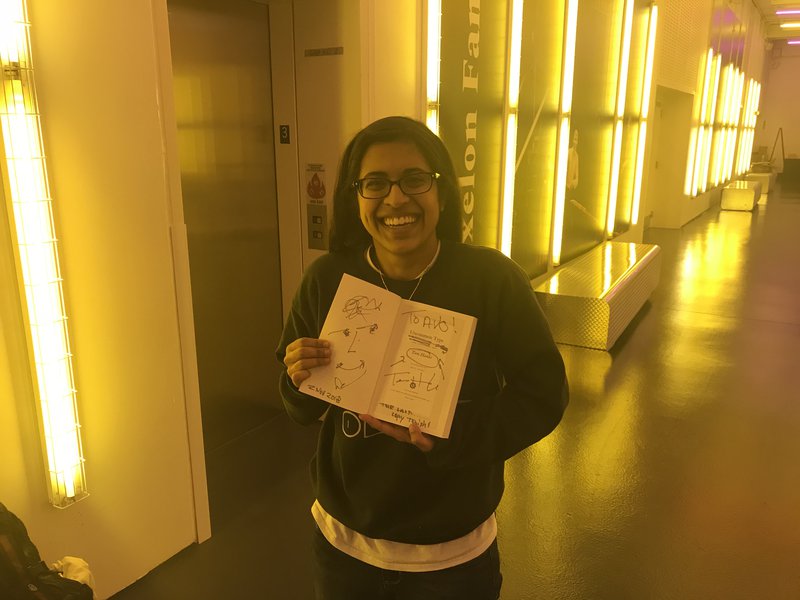
Thulasi Seshan, an astrophysics major and staffer with CHF's bookseller partner, Seminary Co-op, holding her specially signed book after a far-reaching conversation about astrophysics during a book-signing assembly line with Tom Hanks.
- Before his conversation with Peter Sagal, Tom Hanks generously signed 2000 books backstage with “ten slightly dazed people” from the Chicago Humanities Festival and Seminary Co-op (thanks for the shoutout Chris Jones). The book-signing assembly line talked about books and movies, sure, but also...astrophysics, space, and rocket fuel for nearly three hours. Passionate about typewriters, language, space exploration, and all kinds of things, Hanks later gave some parenting advice during his conversation: “Get out two sheets of paper. Type your kids a letter. Hide it away for when they’re much older. It's as unique as a snowflake: a well-written letter that comes from the heart is as special and unique as a Warhol screen print or a Gaughin painting.”
- Jessica Hopper, talking about her time in Los Angeles: “Palm trees aren't trees, they're decoration.”
- When asked if dark chocolate is good for you, Marion Nestle claimed confidently, “Only if you eat a pound and a half a day!” She advised: “Eat everything in small amounts. Love what you are eating, it's one of life's greatest pleasures.”
- Dessa confessing a childhood activity: “When I was little, I would sing while we were shopping for pasta hoping to be 'discovered’ in the aisles.”
- And Martha Nussbaum gave us a kind shoutout: “Even if we feel despair we must actively focus on hope. I think this Festival is an example of hope.”
A number of presenters were cross-pollinating one another; we caught a few:
- Writers Jos Charles and Kazim Ali left to explore local bookshops together after their Saturday programs.
- Nikole Hannah Jones and Carol Anderson were spotted hugging it out at the entrance to Kiese Laymon's program. Nate Marshall, Niala Boodhoo, and Natalie Moore were among other Graphic! presenters also in the Heavy audience.
- Abbi Jacobson and Tom Hanks were sad to keep missing each other while on similar book tour stops.
- Chris Ware gave a shoutout to an iconic Chicago collective, also featured in this Fall Festival: "I moved to Chicago because of the Hairy Who...they took the language of comics to talk about what it means to be a human being. They're the reason I moved here from Texas."
Become a Member
Being a member of Chicago Humanities is especially meaningful during this unprecedented and challenging time. Your support keeps CHF alive as we adapt to our new digital format, and ensures our programming is free, accessible, and open to anyone online.
Make a Donation
Member and donor support drives 100% of our free digital programming. These inspiring and vital conversations are possible because of people like you. Thank you!