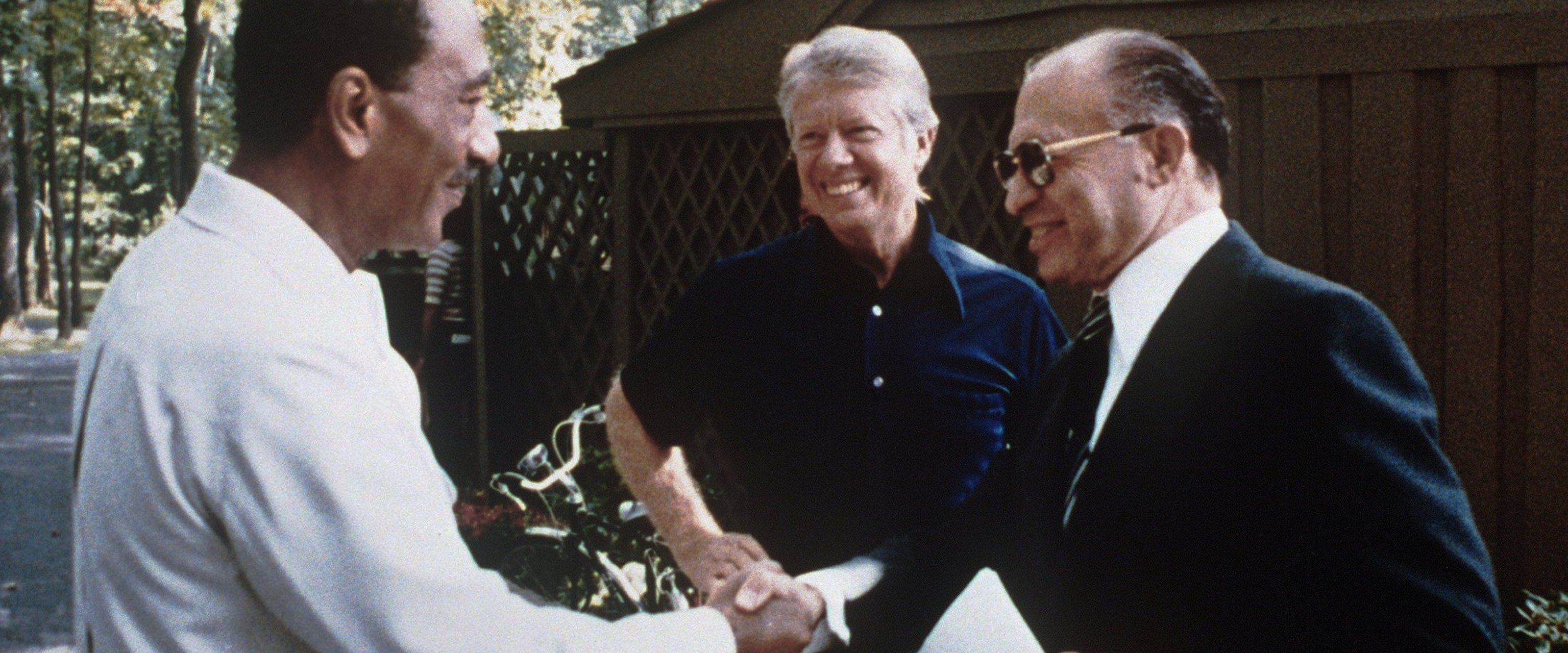
Political leaders are often defined by the wars they wage or the peace they create, despite the impact of their other achievements in the cultural or social realms. Several CHF speakers have analyzed critical points in the administrations of powerful US presidents who inherited, prevented, or sanctioned war. These speakers illuminate the humanity of past presidents, and in doing so they debunk the myth of leaders who are born powerful.
Watch the playlist to learn how Lyndon B. Johnson went from mopping floors in the White House to becoming the president, how Jimmy Carter accidentally changed the course of history by signing a photograph, and how Barack Obama asked Theodore Roosevelt for advice at a dinner party.
The biographical, historical, and journalistic explorations of presidential legacies featured below frame history as a cyclical pattern of war and peace. Faced with the persistence of numerous conflicts around the world, we are left to ask, in times of turmoil, what makes good leadership? And what are the public responses to figures who practice new models of leadership?
"Suddenly the mood of the people changed, that is the mystery of leadership, the mystery of words." - Doris Kearns Goodwin
Historian Doris Kearns Goodwin (Graphic! Festival 2018) argues that it is important for leaders to “understand the power of words.” Noting the breakdown of communication and trust in Trump-era America, Goodwin encourages optimism. She cites the 116th Congress, comprised of leaders who assumed power in order to “change the nature of our culture.”
“I had hoped to write ‘this is where your grandfather and I made peace in the Middle East.’” - Jimmy Carter to Menachem Begin
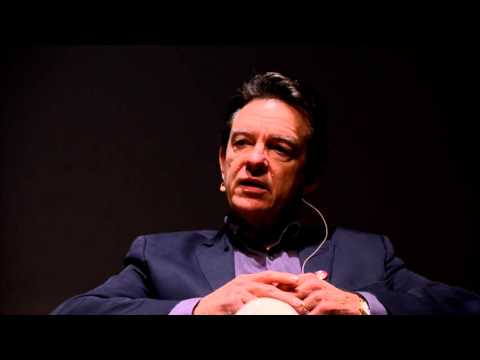
Journalist Lawrence Wright (Citizens Festival 2015) explains how Jimmy Carter persuaded Menachem Begin to sign the 1978 Camp David Accords by gifting Begin’s grandchildren a signed photograph of the two men. Wright suggests that the quality of a good leader is the ability to “acknowledge his enemy as a partner in peace.”
“America is impatient because...in this country [you] have been so full of desire for change and achieved so much and changed so many times." - Maria Lipman
Journalist Maria Lipman (The Body Festival 2010) describes America’s emotional response to the 2008 recession and 2010 midterm elections, which she diagnoses as an inability to see into the long term. Lipman examines the global perception of Barack Obama’s leadership and how he represents the mythic power of the “American Dream.”
Header photo credit: Wikimedia Commons Public Domain
Become a Member
Being a member of Chicago Humanities is especially meaningful during this unprecedented and challenging time. Your support keeps CHF alive as we adapt to our new digital format, and ensures our programming is free, accessible, and open to anyone online.
Make a Donation
Member and donor support drives 100% of our free digital programming. These inspiring and vital conversations are possible because of people like you. Thank you!