Margaret Atwood Opens Her Book of Lives
S5E1: Margaret Atwood
Apple Podcasts • Spotify • Overcast
Margaret Atwood is joined in conversation with author Elif Batuman to unfold the story of her life, linking seminal moments to the books that have shaped our literary landscape, from the cruel year that spawned Cat’s Eye to the Orwellian 1980s Berlin where she wrote The Handmaid’s Tale.
As we travel with her along the course of her life, more and more is revealed about her writing, the connections between real life and art, and the workings of one of our greatest imaginations.
Subscribe to the podcast • Let us know what you think by taking the short survey
Read the Transcript
[Theme music plays]
ANTHONY FLEMING III Hello everyone and thanks for listening to Chicago Humanities Tapes — the audio extension and archive of the live Chicago Humanities Spring and Fall Festivals.
At Chicago Humanities, we connect people to the ideas that shape and define us, and to the lifelong exploration of what it means to be – and stay – human.
For more information on events and how to support Chicago Humanities by joining us as a member, visit chicagohumanities.org.
On today’s episode, Margaret Atwood, the legendary author of more than 50 books, discusses her newest work, Book of Lives: a memoir of her magical life.
Here’s Margaret Atwood talking with Elif Batuman on November 8th, 2025 at the Francis W. Parker School in Chicago.
[Theme music plays]
[Applause]
ELIF BATUMAN Thank you so much for the introduction and thank you all for being here. And I could not be more excited to help commemorate this incredible and gorgeous book. And I believe you're going to start us out with a reading from the beginning.
MARGARET ATWOOD That's the idea. In fact, it was your idea.
ELIF BATUMAN It was a group idea. I'm gonna get very bossy later, so well.
MARGARET ATWOOD You can join the younger members of my family.
ELIF BATUMAN And get in line, right?
MARGARET ATWOOD Alright, this is from the introduction: "Some years ago, I was asked to make a stunt appearance on a comedy show. The host, Rick Mercer, was doing a series in which people well known for one kind of accomplishment, such as writing, astonished viewers by doing something different and entirely unrelated, such as rolling a joint. I want you to be a hockey goalie, Rick said. Oh, I don't think so, I said. Couldn't I maybe just bake a pie or something? No. You gotta be a goalie. Why? Because it'll be funny. Trust me. So I was a goalie, in a full set of pads, with gloves and a stick. There I am on YouTube, still goalie-ing it up; and yes, it is kind of funny. I wore my own little white figure skates with black socks over them to make them look like hockey skates. But you can't slide and stack the pads in figure skates, so those feats were performed by a body double — an accomplished women's hockey player. With her face mask on, you can't tell that it isn't me. It's the job of the body double to take the risks you yourself are too sedate or chicken or unaccomplished to take. I wish I could have a body double in my real life, I thought. It would come in so handy. Of course I do have one. Every writer does. The body double appears as soon as you start writing. How can it be otherwise? There's the daily you and then there's the other person who does the actual writing. They aren't the same. But in my case, there are more than two. There are lots."
ELIF BATUMAN Thank you. I love that passage because it's it's so funny, which is very representative of the book. And I also really like that idea for organizing a biography as it's sort of a history of all the different people that you've been and different characters you've inhabited. Actually, if we could have the first slide, please. Which I don't think we're gonna be able to see, but it's the picture of —
MARGARET ATWOOD Yeah, the first one is not actually me in that box.
ELIF BATUMAN Yeah.
MARGARET ATWOOD It's my brother.
ELIF BATUMAN Oh, yeah.
MARGARET ATWOOD So in that little box you can just see a little foot sticking up and that is my older brother. And where we are is in the Quebec North Woods. They would have been living in a tent. Those chairs would have been made by my father, who is good with an ax. And then the picture beside it is me and my Greb work boots, on a canoe trip. Yes, I say in the book Graeme plied me with gifts. Actually he plied me with a gift, which was not a bouquet of flowers or bottle of perfume or sparkly jewels, it was a pair of Greb work boots. [Audience laughter]. Showed what he had in mind.
ELIF BATUMAN I guess one question I had was one of the the characters that you describe in the book is Peggy Nature. And I was wondering if you could tell us a little bit about her and about the role of nature in your upbringing and how it informed your life and your work.
MARGARET ATWOOD Okay. So Peggy Nature comes. Peggy was my name growing up because my mother's name was Margaret too, and you couldn't have two Margarets, you would get very mixed up. So I had a nickname and I didn't actually use my Margaret name until I became a writer. And that happened because a friend of mine who was in the writing biz said, if you call yourself Peggy as a writer, nobody will take you seriously. It's inherently frivolous name.
ELIF BATUMAN I think you were M. A. For a while too.
MARGARET ATWOOD I was initials for a while, so nobody would know I was a girl. But then I moved on to Margaret and that's the person who writes the books. [Whispers] It's not me. [Laughter] So Peggy Nature was a summer job I had for 3 years at a coed summer camp in a little bit in the north. So there's north, northity north, northy north, north, north, north. And this was just sort of north. [Audience laughter]. So north enough for the black flies and mosquitoes, but not above the tree line. Okay, so it was a coed camp and I got the job because I did know a lot about nature and I knew a lot about nature because I grew up with a biologist father and he was a field biologist at that time, and we spent a lot of time in the woods. Field biologist means you're out in the field collecting things rather than in a lab all the time. So that's how I got to be.
ELIF BATUMAN Like you.
MARGARET ATWOOD Yeah, sort of. Yeah, so he knew as much as he did because he grew up in extremely backwoods, backity back backwoods of rural Nova Scotia. In the early part of the twentieth century. So I always ask people when they were born, because it lets me know what they will have lived through and what they will remember firsthand and what they may only have heard about. And I do the same for my characters in books. I find their I find out their birthday to the month and day. Sometimes I cast their horoscopes and year. And I write the months of the year down the side of the page and I write the the years across the top and that allows me to pinpoint exactly how old they were at any given date. And it also lets me know what they would remember, what was happening when they were 5, what was happening when they were 15, what was firsthand for them, what was prehistory, prehistory is anything before you were born as you know, the lives of your parents are prehistory.
ELIF BATUMAN Yeah. I love that this book shows you as a child throwing tin cans at a cutout of Hitler. Like that's where —
MARGARET ATWOOD Oh we were yeah, it was something you did. [Audience laughter]. Yes you collected tin cans for the war effort and one way of people amassing them was to go and throw them in a picture of Hitler. So therefore the —
ELIF BATUMAN As a way of attracting the cans.
MARGARET ATWOOD The cans were then attracted. The children got to participate in the activity. Rather than just sort of boringly collecting tin cans and handing them over. Like that. Would you like to know what else you had to collect?
ELIF BATUMAN Yeah, absolutely.
MARGARET ATWOOD Some people know in this audience, but not very many. No, we collected newspaper. You collected bacon fat. I don't know why, but I think they were used it was used for greasing bullets or something like that. You collected anything made of tin or metal. You also of course had had ration cards. So some things you collected, other things you used quite sparingly because those things were rationed and and that would be butter, eggs, milk products, meat, cheese, anything else?
ELIF BATUMAN We were just looking at your Caffè Nero card.
Caffè Nero is a cafe chain in England where I'm going next. And when you have a coffee in Caffè Nero, they stamp your card. And when you've got ten stamps, you got a free cup of coffee. Yes. Yes. Depression parents, war baby, I'm very scroogey. [Audience laughter]. If I have a chance to get a free cup of coffee out of my Caffè Nero card, I'm gonna do it. [Audience laughter].
ELIF BATUMAN That's very wise. Okay. On the themes of nature and historical change, may I ask you to read the second passage, The Oryx and Crake?
MARGARET ATWOOD Yeah.
ELIF BATUMAN That's gonna add —
MARGARET ATWOOD We'll continue with Peggy Nature because I think this is what you're getting at. I have a friend who just hated nature and was a camper when I was doing the nature program at this camp and said he avoided me like the plague. We were called our names came from what we were teaching. So there was Jerry Swimming and Beryl Arts and Crafts and therefore, I was Peggy Nature.
ELIF BATUMAN Arts and Crafts became an artist, right?
MARGARET ATWOOD That was the assistant to the arts and crafts person. Yeah, he was only fifteen at the time, so he wasn't Charlie Arts and Crafts. He was just a secondary player who went around for years afterwards saying I had made him stroke a toad, which I had not. You can't —
ELIF BATUMAN How can you —
MARGARET ATWOOD You cannot make somebody stroke a toad. They have to wish to just stroke a toad. [Audience laughter]. Yes, I invited him to stroke the toad. Yes, anyway, there he was. So that's why I was Peggy Nature like that. So I was in a tall business building recently in the in the reception coming to or from some attempt to get some money out of somebody to save a birds. An attempt in which I succeeded. And I was sitting there and this no, it wasn't the guy who stroked the toad. It was was one of my campers from long ago who would have been seven at the time. So this bald recently retired lawyer came up to me and said, Peggy Nature is it really you? [Audience laughter].
ELIF BATUMAN My favorite part is that then you say, Yes, it really is.
MARGARET ATWOOD Yes. It is I.
ELIF BATUMAN She's in there. Yeah, I find that so moving. Okay.
MARGARET ATWOOD I also taught them to make fires, these little seven year olds. And I hadn't. I thought afterwards maybe this wasn't such a good idea. They may have gone back to their urban homes and set fire to their parents' garages. But they I don't think they did. You think it would have happened anyway? [Audience laughter].
ELIF BATUMAN Okay. Shall we go to that bizarre passage that I chose or just skip it?
MARGARET ATWOOD You think this is bizarre?
ELIF BATUMAN No, no, I think the chapter I chose was a little the part that I chose for you to read, I thought it made a lot of sense. I chose it in the woods in New Hampshire and it made perfect sense. And then I got here and I was like as you were reading it and with the last sentence about the time of peace and commerce is over.
MARGARET ATWOOD Never mind, we'll get to that. [Audience laughter].
MARGARET ATWOOD Yes, okay. Yes, what people find odd varies from individual to individual.
ELIF BATUMAN We'll test out we'll see what —
MARGARET ATWOOD "In the early spring of 2001, to recover from the stress of The Blind Assassin publication, Graeme— and I went on an epic jaunt to Western Canada, New Zealand, Australia and Japan, where I combined interviews and book promotion with bird watching and temple visiting. It was on this trip that I began Oryx and Crake. We were in Arnhem Land, the far north of Australia, and the most tropical part, where we took a small bush plane to an area of Kakadu National Park that was inaccessible by road. We stayed at Davidson's Arnhemland Safaris, a glamping outfit run by Max Davidson, an old bushy guy like my father, who had an agreement with the aboriginal owners of the land. The camp was basic. We slept in tents and showered in outdoor stalls where giant katydids, mantises and stick insects observed us. We were guided by Max himself, who showed us rock paintings dating back fifty thousand years, and edible plants. We ate the local fish, including Barramundi, which changes from male to female when it reaches a certain weight. Ooh. [Audience laughter].
MARGARET ATWOOD Max also gave us gave us some crucial advice about crocodiles. And I'm telling you this for your own good. Never brush your teeth at the same spot beside the river more than once because the next time the croc will be behind you, will push you into the water and will drag you under a log to tenderize you before it eats you. The people here never changed their way of life, said Max, because they didn't have to. They had everything they needed right here, which caused me to think what do we need as humans? What is it about us, we humans of today that causes us to have infinite and conflicting wants and is also causing us to destroy the biosphere in search of them? And if some of our basic needs were removed, domestic animal meat and agriculturally grown food, clothing, competition for mating partners, the aggression we show in evading or protecting territory, would our optional wants be different? And in the age of CRISPR gene splicing, how easy would it be to alter our basic needs. From my journal Keeling Island, May 10th, 2001, I wrote the first page of Emu and Crake after getting the idea in March and making notes in April. Then at the end of May, I was making some notes and writing some pages of what is now Oryx and Crake. I must have decided that the vowels in Emu were too soft and that Oryx was better, having a spiky x and a harsh r, as well as an enigmatic y. We continued writing in the Mackenzie Mountain Barrens near the Canal Road. This is up in the Northwest Territories, a setting I was to use much later in MaddAddam. I wrote still more on the first of many jaunts to the Canadian Arctic. I was making rapid progress until I reached the end of section seven, when the protagonist is about to set out on his journey to the elite gated compound where he grew up, searching for tinned food left there among the ruins. And... it was September 2001. I was sitting in Toronto's Pearson Airport. Waiting to get on a plane to New York for the paperback launch of The Blind Assassin. I was knitting. People weren't yet afraid of being knitted to death. What? Planes. Then my friend Jerry Kaplan from Camp White Pine Days came over to me and said Hi, Peg. We're not flying to New York. Why not? I said. He motioned to a TV screen where they were replaying a shot of a plane flying into a World Trade Center tower. Flames were shooting out. Oh dear, I said. One of the pilots must have had a heart attack, and there's been a tragic accident. We both rebooked our flights. Then a second plane flew into the other tower. It was evidently no accident. I went home where a white faced Graeme was relieved to see me. He'd been listening to the radio and was worried that I was already on an outbound plane. Box cutters, useful for slashing throats, were later rumored to have been found on that particular plane. History was not over as had been claimed in the 1990s. It wasn't going to be peace and commerce forever."
ELIF BATUMAN Thank you very much for for reading that. I really wanted the audience who might not have had time to read the book yet. I just thought that that that excerpt really summarizes what a generous, lively, useful, I mean, the thing about the crocodile, you've it's full of little tidbits like that that you file away. And you know, it might not come in handy, but if it does come in handy, it's gonna come in really, really handy. And it's just as a reader, I just feel like this book is such a gift for people who who love your novels. Cause as a reader, those are the exact things that I want to know. You know, where did you get the idea? What was the title first? Just knowing that Oryx and Crake used to be Emu, and Crake was just amazing. How did the idea change over the incredibly long time that it takes to write a novel? So my first question is, and then a lot of writers either they don't they don't tell you those things. Either they're cagey or they don't know them themselves or they they don't tell you. So the first question I had for you is —
MARGARET ATWOOD Do you ask?
ELIF BATUMAN Sorry.
MARGARET ATWOOD Do you ask them?
ELIF BATUMAN Well, I think people write memoirs and they don't always include that information. That's not the first thing that they put in, you know? Well, this is my question for you. Maybe your experience was different. As a reader and as a Victorianist or a lapsed or recovering Victorianist —
MARGARET ATWOOD Once a Victorianist, always a Victorianist.
ELIF BATUMAN So past, present, and future Victorianist. You must have read a lot of accounts of both satisfying and unsatisfying accounts of writers and what they write about their work. And I'm curious how that affected your thinking about what you wanted to include in your book for other readers who feel the same way about you that you feel about the reader.
MARGARET ATWOOD I didn't used to pay any attention whatsoever to writers talking about their work because I grew up in the age of explication de texte which meant that you analyze the text, the text and nothing but the text. And the writer was just kind of superfluous. So I wasn't that interested in such things when I was younger, but I've become more interested in them. So yeah, usually you find out those things through biographers rather than writers themselves. These biographers are writing about things that you might wish to know, but that the writer already takes for granted. So I say to young people, if you're writing about our times, please explain what a toaster is because the future may not know. And the hardest thing that I found to research when I was writing Alias Grace, set in the 1840s and 1850s, it's the undergarments because you have fashion plates of that time. You can see the outerwear quite easily. You can even see the footwear, but you could not see the undergarments. So I had to do a certain amount of delving, as it were to get to that. The French are often a good source of information about this. They even write books of theory about undergarments called le dessus et le dessous. The above and the below. Yeah, and if you're really interested in this stuff, there is a YouTube series by a historical fashion recreator and what it what is it called, I'll have to tell you in a minute. But she's her her job is making historical costumes. And she shows how you would have gotten dressed in say 1792. So what you would have put on first, what you would have put on over that, how you would have done these things up, what you would have put on over that, all of the layers. Very instructive. If you want a rundown, a very good rundown, it's by Millia Davenport. It's quite an old book. It's very thick. And it's called The Book of Costume. So yes, it's a it's a very interesting human motif which has been with us from the beginning and hasn't stopped yet. But in Oryx and Craig nobody wears any clothes.
ELIF BATUMAN Well and there's a passage where he explains it so he has to explain a toaster. He tells some kids you eat toast and they're like, what's toast? And then he goes through the whole thing.
MARGARET ATWOOD Yeah, but he gives up because it's just incomprehensible to these people who have never had electricity, never had a toaster, never had a slice of bread.
ELIF BATUMAN And the butter.
MARGARET ATWOOD What is butter? Yes. Yellow grease made out of the mammary glands of a cow. [Audience laughter].
ELIF BATUMAN Oh, this is really helpful and you actually have a lot of— [Audience laughter].
ELIF BATUMAN Well I was thinking that it was helpful what you said about clothes because actually your book has a lot of helpful details because you made a lot of clothes and you talked about how you made them and what they were and how they changed over the time. Just so —
MARGARET ATWOOD Yeah, sewing, making clothes. I was always interested in what people put on themselves because of course any dressing up, any putting on clothes is a is a form of self presentation. Body doubles. And yeah, or you can change your appearance. And if you read a lot of spy novels, which I do, that gets into it quite a bit. You go into the washroom and change your clothes, come out a different person. Yeah.
ELIF BATUMAN Maybe we should do that in the middle of the questions, we should just go change and come back.
MARGARET ATWOOD I could be you and you could be me. Well, I could get into your clothes, but I don't think you can get into mine. [Audience laughter].
ELIF BATUMAN I guess another thing that was really striking to me in the passage that you read is that you start writing this book. So you describe having the idea in Australia in May 2001. And then you're writing basically like one of the great terrorism novels of our time, and then you're working on it when 9/11 happens, and that sort of informs the rest of it. Actually, could we cue up the second slide, please? This sort of wasn't—
MARGARET ATWOOD Is that the second slide?
ELIF BATUMAN Yeah. That's I told you so. I was just so a lot of people describe you as as prescient, which you know, I totally understand how they say that. The most striking example maybe is The Handmaid's Tale tv show where it starts filming in November or in the fall of 2016 and everyone thinks Hillary's gonna win. And then in the middle you realize that you're making like the defining tv show of the Trump era. So I was just curious how you think of that. How do you feel about the term prescient? Do you think that there's something kind of more complicated going on or maybe less complicated? Or I just wanted to ask you about.
MARGARET ATWOOD I think I think writers all are in the land of what if in some way. So what if someone gets up in the morning and everybody else is gone? There are books like that from the late 19th century. Or what if some of the things that people were saying in the early 1980s, which saw the rise of the so-called religious right as a political force? What if they had the power to enact some of the things they were saying they would like to do and then actually did it? How would that work out? So if you wanted all women to be back in the home, how would you get them there? How would you round them all up now that they're running around having jobs and credit cards and apartments of their own parish the thought how would you get them back into say 1850? So it's partly working that out and partly —
ELIF BATUMAN Which is maybe the same thing they're thinking and that's why you wind up in the same place.
MARGARET ATWOOD Yeah. Of course, some people object to having you say out loud the thing that they have said themselves they want to do, which is a paradox for me, you know, this is what you want, here it is. You know, why aren't you saying hooray? Which some of them actually did.
ELIF BATUMAN Did anyone say hooray?
MARGARET ATWOOD Yeah. Yes, Margaret, you have such a good idea. You've shown us how to do this. Oh yeah, so you have to watch that part. So it's working it out. And so I've never believed, having been born in 1939, remember what I said about the dates. Oh I've never believed anyone who has said it can't happen here. Because any anything can happen anywhere given the circumstances. And just by the way, it's a real big invitation to actual criminals to send people out in marked cars with their faces covered to grab people off the street. Because the next thing that's gonna happen is that other people are gonna pretend to be those people. And you will not be able to tell the difference. It's like excuse me, the Boston Strangler who dressed up as a person from the gas company. And if you watched any Oceans Eleven, etc. As I have, one of the things they always do is is dress up to be people that they aren't, and that's how they just grab the jewels out of the Louvre. So just really a bad idea, kids. To let unidentified people unidentifiable people going around grabbing people off the street. As you'll be next. And what they want is your pocketbook.
ELIF BATUMAN Wow, yeah. I hadn't thought of that.
MARGARET ATWOOD Why ever not? Oh it's one of the first things I thought of. Yeah.
ELIF BATUMAN That's why you're you. [Audience laughter]
ELIF BATUMAN Maybe let's go to the next slide. So this is just sort of to return to the theme of history and historical change and the the I think you can get a sense already of the huge historical scope of this book and how kind of granular and satisfying it is.
MARGARET ATWOOD It's a very nice way of saying I'm really old.
ELIF BATUMAN I'm gonna pass that over. [Audience laughter].
ELIF BATUMAN Plenty of people are really old and are not granular and interesting, but okay.
MARGARET ATWOOD You can be both. You can be both.
ELIF BATUMAN Yeah, yeah. There's a you the place in the book where you point out that especially when we're younger, we don't think of ourselves as living in a historical period. It feels like, oh, history though the historical periods were in the past and now it's now. And that at a certain point you start seeing historical periods expire and you understand that, but you live in history. I guess my question was now that you've undertaken this kind of big retrospective undertaking of writing this book, did it make you understand your books or your life as more historically conditioned than you experienced them at the time? It sounds like maybe you already experienced them at the time as being pretty historically conditioned, like you were smarter than a lot of people.
MARGARET ATWOOD Well, by the time you get to that age of really thinking about it, which let's say it's 20. You've already been through a few big changes. And the odd thing about it is that things that happened maybe ten years ago seem really ancient. Especially when you're younger, they seem like really olden days. But then there's a there's a funny thing that happens that that quite distant periods seem to come closer. So the 1920s come closer in time, I think possibly because the more time you've lived through. But when we were in the early 1950s in high school, World War II, which had just ended in 1946, seemed very, very long ago. But it wasn't at all. So there are these funny things that happen with time as you as you move through it, or it's as I say in a consoling manner to weepy 15 year olds. Oh, this is a tragedy now. When you're 30 you'll think it's funny. And when you're 65 you won't be able to remember that guy's name. You just have to get through this part.
ELIF BATUMAN How does it change the writing process or the thought process when you know that like your audience is over so many different ages, like you said, and everyone knows and remembers different things. Is that a calculus that's always going on? I mean, I feel like it is for me already.
MARGARET ATWOOD Well, you never know who's going to read your book. So the contract when you're writing a book is between the writer and the book. And the contract with the reader is between the reader and the book. It's not really a contract with the writer at all. The book is the go-between. It's the one that's carrying the message. And that's why, for instance, when you're you're reading Chaucer, you think I'm reading Chaucer. Oh, you're not having a personal relationship with Chaucer, who's been dead for some time. At least I don't think you're if you are having a personal relationship with him, it's a different kind of problem. But you are hearing his words, the words that he set down, and quite frequently, you know, for other people because he writes for characters. So that's how it goes, but you you cannot know who is going to be reading that. He had no way of knowing that sometime in the 1950s, which he would not have been able to even think about probably, I would be reading what he had written so long ago and identifying with it. So people bring their own experience to whatever book they're reading, and they're all going to have an a different reading of it. So if you think of it as music, so yes, it's always Mozart, but this person playing it and these other people listening to it are different from somebody else playing it and those other people listening to it. There is a book which I'm sure you're aware of called Reading Lolita in Tehran, you know, which of course was quite a different way of reading it. And it's quite a different way of reading a book when that book is is banned or censored. You're going to read it differently because a different frame has been put around it. I'm old enough to have known. Here we go. Some writers from the old Soviet bloc who wrote in Samizdat. And so they wrote in secret manuscripts that were passed from one writer to another and sometimes made it out into the Western world. So that circumstance of writing is very different from me sitting at my little computer, you know, bashing out the pages. I don't think somebody's gonna come through the door and arrest me because of what I've written. At least I don't think that yet.
ELIF BATUMAN That's one of the most amazing parts of the book, actually, is when you get the idea for Handmaid's Tale sort of from the Harvard vibe and Salem and the Puritanism. And then you're working on it in West Berlin. And then in in the early 80s, you visit the Soviet bloc. And there's a moment in Poland where you see a church procession and think this is where it's gonna crumble. It's like, yeah, it's such an incredible book. It's so rich. Sorry, that didn't have a question.
MARGARET ATWOOD And it did crumble. It started —
ELIF BATUMAN Right.
MARGARET ATWOOD Yeah.
ELIF BATUMAN Well and then just thinking how that must have also informed Handmaid's Tale, just to think of it as a triangulation of all of those things.
MARGARET ATWOOD Chauncer then there's also the testaments, because The Testaments, which is the sequel to The Handmaid's Tale, takes place at a moment of internal crumbling.
ELIF BATUMAN Oh, interesting. Well and The Testaments it seems like it was catalyzed by Me Too a little bit or a lot.
MARGARET ATWOOD No.
ELIF BATUMAN No.
MARGARET ATWOOD Yes? I don't know. In what way?
ELIF BATUMAN I thought there was that case that the the professor Galloway and that you were —
MARGARET ATWOOD That's not in the — oh I see. In the memoir I say, yeah, there was there was an atmosphere of fear.
ELIF BATUMAN Yeah.
MARGARET ATWOOD That wasn't Me Too. It was actually a little bit before Me Too. Oh yeah.
ELIF BATUMAN Yeah.
MARGARET ATWOOD Yeah, if you work out the dates, yeah. No, the interest for me is very simple. It's a human rights interest. I'm of the human rights generation, as it were. So human rights comes in late 40s. I'm in high school in the fifties. Feminism second wave doesn't appear until '79. No no '69. It was burbling away in sort of underground circles in New York before then, but nobody else knew about it. And we didn't really.
ELIF BATUMAN That's the thing about book two, to see you kind of being a proto-feminist and then you're like, but we didn't think about it in this particular way because second feminism hadn't happened.
MARGARET ATWOOD Hadn't happened yet so Simone de Beauvoir had happened. But her experience, you know, bourgeois France in the early part of the 20th century was so remote from mine that I had a hard time getting my head around it. And the other one was Betty Friedan. Okay. And again, that was more about the generation before mine than it was about mine. So I knew about those things, but they seemed sort of then rather than now. If you see what I mean?
ELIF BATUMAN Yeah.
MARGARET ATWOOD I mean when you're running around doing rock and roll, you're not in the world of Simone de Beauvoir's strict bourgeois upbringing like that. Where did we start this? Oh yeah. Aunt Lydia my experience with this this case in which somebody was condemned without being —
ELIF BATUMAN Yeah.
MARGARET ATWOOD Put on trial and was condemned for something that nobody actually knew what he was being condemned for. You can't have that. It's like Stalin show trials. A lot of those people didn't know what they were being accused of at all. So that's why and now that you've seen rule of law being floated on many sides, that's why we need rule of law and sure it doesn't work on numerous occasions. But what you do then is change the law. You don't just throw the law out the window like that. Yeah, so I did get quite attacked for that. I got attacked for saying human rights can you imagine? But I think a lot of thos e people have now changed their minds.
ELIF BATUMAN I'm sure they have.
MARGARET ATWOOD Oh I know they have dear.
ELIF BATUMAN I guess one question, speaking of The Testaments, I really enjoyed seeing because you've written a lot of books with sequels, and I really enjoy reading about where the first book appeared in your life, and then time passes and the book exists in the world, and then you decide to write a sequel. This may be kind of a weird question, but I was wondering if you could compare the process of writing a memoir and writing a sequel, because they both seem sort of like another shot if that's completely ill formed, then —
MARGARET ATWOOD No, I think you're quite yeah, you're quite right, sure. My Book of Lives a Sequel. [Audience laughter].
MARGARET ATWOOD To to my actual life.
ELIF BATUMAN That would be amazing.
MARGARET ATWOOD Yeah. I think we can make something out of that.
ELIF BATUMAN I think so.
MARGARET ATWOOD If we tried quite hard. But I think there is something there. Yeah. Are they the same? Well you're revisiting—
ELIF BATUMAN Yeah.
MARGARET ATWOOD Things that you already presumably knew about at the time and may have changed your point of view about that's certainly true. I'm not sure where we go from there.
ELIF BATUMAN Yeah, okay. We have an idea for a future project that I think your publishers are gonna be very excited about.
MARGARET ATWOOD I'm going to write a sequel to my sequel.
ELIF BATUMAN It's a Book of Lives sequel. There are details to be worked out, but I think that's we'll table that for now.
MARGARET ATWOOD Can I put my funeral arrangements in? That was in bad taste. [Audience laughter].
ELIF BATUMAN No, I guess it's an actual question. Maybe we could have the next slide.
MARGARET ATWOOD My book of afterlives.
ELIF BATUMAN Well I mean speaking of —
MARGARET ATWOOD I went to the hearing guy, a young man in his mere 40s. And he said to me, well, for a person in your demographic, you have remarkably good hearing. And I said, that's because most people in my demographic are dead.
ELIF BATUMAN Or like most people in my demographic don't want to hear what the people in your demographic are saying. So they're like oh —
MARGARET ATWOOD And they're not hearing anything or we don't think they are.
ELIF BATUMAN Okay, so this is your star chart, which one thing I really like about this book is that the star chart comes up early and then it it's kind of a continual relevance and it sort of ties into the passage that you read about the beginning with the body double. Also you're a Scorpio with Gemini rising and I'm Gemini with Scorpio rising, and a lot of the yes, sorry, my hand's a little damped, but a lot of the stuff that you said was extremely relatable. So well, let's see, what's the question? I guess well, one question is just how how you think about your star chart because it's sort of like tongue in cheek of to what extent do you actually think about it and how that duality sort of —
MARGARET ATWOOD You mean do I believe in it?
ELIF BATUMAN Do you believe in it? And how is that duality like regardless of whether you believe in it, like that clearly that model is useful of thinking about the the Scorpio and the Gemini and the Hermes and the Apollo and the Jekyll and the Hyde and the writer being two people? Yeah, I guess I was just curious about that.
MARGARET ATWOOD All right, so back to where I learned how to do it. So it's Edmonton, Alberta, somewhat to the north west of here. And it gets very, very cold there, colder than here. Not as windy as here, but cold. And it's usually quite in the one hour of daylight that you get. It's usually quite bright and clear. But it rained one year and then it froze, and so everything was covered with ice, didn't melt for quite some time, and it was quite dangerous to go out. It's quite slippery. So they don't put salt on things there because it's too cold. They put sand on them. So there I was in my dark Edmonton apartment surrounded by ice. And below me lived a Dutch art historian called Yetskus Abisma. And Yaskus Abisma was an expert in Hieronymus Bosch. He writes those surreal he drew those surreal, you know, a garden of earthly delights, etc. And a lot of his paintings have these weird little figures in the —
ELIF BATUMAN The cover for one of the Oryx and Crake or —
MARGARET ATWOOD I think they made that one up, but it looks like that. Yeah. So these weird little figures in the early twentieth century and even the mid-twentieth century, people were in the habit of interpreting them as emanations from the Freudian or Jungian unconscious. And Yetskus Abisma took issue with this and said that she thought that they were they were from astrological textbooks of the early Renaissance. And she was going about proving this, and in order to do that, she had to know how to draw horoscopes. So in the long dark Edmontonian nights, she taught me how to do it too, which in those days you did with a compass and a protractor, whereas nowadays you can go online. But I knew I know how to do them sort of from the ground up. And along with that, because it was part of the same belief system, I learnt palmistry. So Jupiter, Saturn, Apollo, Mercury, the Moon, Venus, Field of Mars, and then you look at all the lines. When they're going, you look at stars, you look at squares, you look at fingerprints if you really wanted to drill down. And you also look at the shape of the hand. You read both hands because the dominant hand is the hand you've played, as in poker. And the other hand, the one you don't use as much, is the hand you were dealt. So you always look at both together. So that's how I know how to do it. Now you're asking me a Scorpio whether I believe in it. So as you know from astrology, Scorpios don't exactly believe.
ELIF BATUMAN Right.
MARGARET ATWOOD They question and they like to know things, but just because you know something doesn't mean you quotes believe that something. And having grown up with the scientists, I make a distinction between knowledge, which is provable, and belief which is not. And that's why I'm not an atheist. Because atheism is purporting to be knowledge about something that cannot be known. Isn't that logical?
ELIF BATUMAN Okay. Now I'm very excited to open up questions to the audience. And in the meantime, since you — I had a question actually where you you mentioned the Freudian and Jungian unconscious. A question I had was whether you had any truck with Jungianism at all. Because when I think about Handmaid's Tale, I start using that like I'm like, oh, she's hit upon something really archetypal with the red cut and it's clearly something that was in the collective unconscious, and maybe that's how the prescience works. And so I was just curious if you thought about that.
MARGARET ATWOOD Well, people of might of generation in study of literature, so that would be the late 50s and the 60s, we all knew about Jung's theories. We knew about them because they're important in literary history.
ELIF BATUMAN Oh yeah.
MARGARET ATWOOD So for instance this novel called She by Rider Haggard, which was wildly popular at the time, wildy wildy. Jung thought quite highly of it. As he thought it was archetypal. Yeah, so we we all knew about those things in of that generation, just as we all knew about tarot cards because of T. S. Elliot.
ELIF BATUMAN Oh wow.
MARGARET ATWOOD It's in the wasteland. So a lot of the things that you know, for instance you want to talk about the antinomian heresy and Christian theology, you have to know those things or you can't read the books or you can't read them with understanding.
ELIF BATUMAN You can explicate the text.
MARGARET ATWOOD Yes, you need well, you need to know those things in order to explicate the text because otherwise you're not gonna know what this whatchamacallit means.
ELIF BATUMAN No, you're not. Well the audience has already pitched some questions —
MARGARET ATWOOD Look at them all.
ELIF BATUMAN I like the second which of your works was most personally transformative through the act of creating and writing and how so?
MARGARET ATWOOD Woo. [Audience laughter].
ELIF BATUMAN Nice question.
MARGARET ATWOOD I think it's a great question. It's not one I'm really equipped to answer very well. Because I don't think much about my personal transformation.
ELIF BATUMAN Oh, interesting.
MARGARET ATWOOD Except insofar as I used to be able to run up a hill. Not gonna do that now.
ELIF BATUMAN Which book changed that? Okay. Cool.
MARGARET ATWOOD Yeah, I'm not of the I think the generation just after mine was very into going to psychoanalysts. I felt quite left out. Yeah. So why don't — I must have a neurosis? Why can't — yeah, anyway. I did go once and the guy just thought I was boring. And that was the impression I got. Does the contract with the reader ever feel like a burden or or even something you've come close to breaking? But I don't have a contract with the reader. I have a contract with the book.
ELIF BATUMAN And the book has a contract with the reader.
MARGARET ATWOOD The book has a contract with the reader. So your job as a writer is to make the book the best version of itself that it can be. That's your contract with the book.
ELIF BATUMAN Inspirational for all the writers in the house, I think.
MARGARET ATWOOD Well, because they can't know who their readers are going to be. If you make the book the best book that it's capable of being, it will fulfill the contract with its intended reader. By its intended reader, I mean the one that doesn't just want to throw it across the room. Oh, so it is message in a bottle. You write the message in the bottle, you throw it into the sea. You don't know who's going to pick it up. So it lands on a shore. Person A picks it up and says, oh, dirty old bottle. Doesn't open the bottle. Person B opens the bottle but doesn't speak that language, so they can't read the message. Person C opens the bottle, reads the message and doesn't like it. Person D picks up the bottle, reads the message and thinks this was written for me. That is your intended reader.
ELIF BATUMAN That's really beautiful. [Applause]. Wow, that's a super specific one. In in the poem Habitation, the line about unpainted stairs has odd spacing. Is it meant to look like stairs? My students don't believe me.
MARGARET ATWOOD Oh, well, that's very specific. I'd have to go back and look at that.
ELIF BATUMAN Ha ha ha.
MARGARET ATWOOD But why not? You know, you're a reader, you have your interpretation. Your students are also readers. They have their interpretations. So it's not really a question of your students not believing you. There may be many things they don't believe you about, but they'll find out later.
ELIF BATUMAN It's the classic —
MARGARET ATWOOD Or we're right all alone.
ELIF BATUMAN Can you speak on the topic of science fiction versus science realism? And where would you take oh wow, where would you take artificial intelligence as you ponder it? Its logical conclusion.
MARGARET ATWOOD Well, that's a good one. We don't know whether it has a logical conclusion quite yet, although we have read science fiction stories in which artificial intelligence takes over, and it's not usually good news for people. But I will take you back to a long forgotten sci-fi story because I read a lot of sci-fi as a younger person. Much younger. So in 1952, I read a book called Donovan's Brain. No bells ring. It was it was a trashy science fiction book. So Donovan, who is a stock manipulator, dies in a plane crash. But luckily there are some scientists in the vicinity who get hold of his brain. And they put it in a fish tank and feed it brain food. [Audience laughter]. Then it gets bigger and bigger and smarter and smarter. But but Donovan doesn't know he's dead. So instead of giving the key to all world knowledge, which is what the scientists have hoped he would do if they make his brain super smart and add more brain food, he still wants to keep on manipulating the stock market. And not only that, he develops something out of Rider Haggard's She, the ability to electrocute people at a distance and also read their minds.
ELIF BATUMAN A complete package.
MARGARET ATWOOD A complete package. Yeah, sort of like artificial intelligence today, scary. And of course they once they realize what they've done, they wanna pull the plug on his fish tank. But he can read their minds and anybody who sneaks in trying to pull the plug gets electrocuted. And the hero who finally manages to pull the plug, is a genius who knows some French poetry. Donovan doesn't speak French. [Audience laughter]. So as he advances on the plug, he recites in his mind over and over again a short poem which puzzles Donovan so much that he doesn't manage to electrocute him before he pulls the plug. Isn't that good? [Audience laughter]. So the problem with AI is simply this. It takes a huge amount of electricity to run AI. Number one of what is going to be the new energy source to run all this stuff, because they're even right now towns that are short of electricity because too much is going into servers. So this vision of the whole world being encompassed by all of these AI servers, you know, just think where are you gonna get them juiced to make that happen. That's number one. Number two, it's a data scraper. So the more data it scrapes, the more false data it scrapes, and the more mistakes it's making. Yeah, we found we asked it, because we fool around with it a bit. We asked it where to find a particular shopper's drug mart in Toronto. And instead of telling us where it actually was, it said it was in the Maple Leaf Gardens, which is where the hockey games used to be played. So you can't trust it. We also gave it a gave it a puzzle, we we gave it a project. And the project was write a dystopian short story in the style of Margaret Atwood set in Winnipeg. Mean on Winnipeg. So it's a data scraper, and amongst the data that it scraped, because it scraped all my books, I know that, I know what you've been doing. It scraped my literate of children's books, in which you know, there's one in which everything begins with r. The story that it produced was called The Weeping Willows of Winnipeg. It got that idea from the children's books. It didn't grasp the central thing about a dystopia which is you're not supposed to get out of it. It's a closed system that's one of the dystopian things about it. So here's all these unhappy people in Winnipeg. Why didn't they just move? [Audience laughter]. There was nothing stopping them. Yeah, like that. So I think there's a few —
ELIF BATUMAN Did it have a happy ending, the book, the dystopian—.
MARGARET ATWOOD No, no, it was a dystopian story. So it ended with everybody just being very unhappy. And we also gave it a poem to write, and the poem was about our Pelee Island Bird Observatory, which is in the middle of Lake Erie and is at a pinch point for bird migration, and where we are currently renovating a 1928 large liquor store into a bird center. I'll give you one guess as to why it was so large in the middle of Lake Erie in 1928.
ELIF BATUMAN I can't imagine.
MARGARET ATWOOD You know. Prohibition. Exactly. Of course it was a jumping off spot for rum runners who were trying to run the US Coast Guard. And that's why it was so large. It was the depot. So that's one of the points where Al Capone used to come up and make deals. He has to go to Windsor and make deals with the liquor producers in Canada and then it was his job to get it across. One of the devices being a cable underneath the Detroit River. Wasn't that clever? Oh yeah.
ELIF BATUMAN Maybe Al Capone is presiding over the bird sanctuary now in some —
MARGARET ATWOOD No, I don't think he was a Pelee guy. He was more a Windsor guy. Yeah, back and forth to Detroit and then to Chicago. Dare I say Chicago. Anyway, we gave it a poem to write about our bird center, which happens to be in a swamp as all the good ones are, with a lot of mud and chiggers. So it wrote a poem in which the because we wanted it to be a positive poem, we said positive, in which the mud was rich and luxuriant and the chiggers were singing. Right.
ELIF BATUMAN Singing.
MARGARET ATWOOD If you've ever if you know anything about chiggers, one of the main things you know about them is they do not sing.
ELIF BATUMAN This is actually a great segue to a surprise development. A surprise to you, I believe, which is I've been in informed that November 18th is Margaret Atwood's 86th birthday. And I've been oh and we are going to be celebrating that, we lucky people in this room, by singing happy birthday all together.
MARGARET ATWOOD Are we doing that now?
ELIF BATUMAN Yeah, we are because we're —
MARGARET ATWOOD So lovely.
ELIF BATUMAN We're like either very like chiggers or very unlike chiggers. I'm not sure which one. But that is how we're going to end this incredibly just fantastic conversation. Yeah, no, I'm completely still starstruck. Okay. So therefore, I now have to sing.
MARGARET ATWOOD Well, being a Scorpio, I'm here to tell you that the only other thing I know that happened on November 18th was a massacre in Ireland under the IRA.
ELIF BATUMAN Wow. Wait, but that's like the game, like there's a horrible massacre and a great human achievement on the same thing. It's like the game that they play in Oryx and Crake.
MARGARET ATWOOD Yes, it's true.
ELIF BATUMAN All right. [Audience laughter]. All right, are we ready? Happy birthday to you. Happy birthday to you. Happy birthday dear Margaret. Happy birthday to you.
MARGARET ATWOOD Oh, That is very sweet. Thank you very much. And what is inside this but a tiny a tiny weeny little chocolate cake? See if I can show it to you without dumping it all over the — cute. Well that's lovely. Thank you very much. Happy birthday in Chicago by lots of happy people, I think.
ELIF BATUMAN Yeah, people you made happy. So thank you. Many happy returns. Thank you all.
MARGARET ATWOOD Thank you.
[Theme music plays]
SHOW NOTES
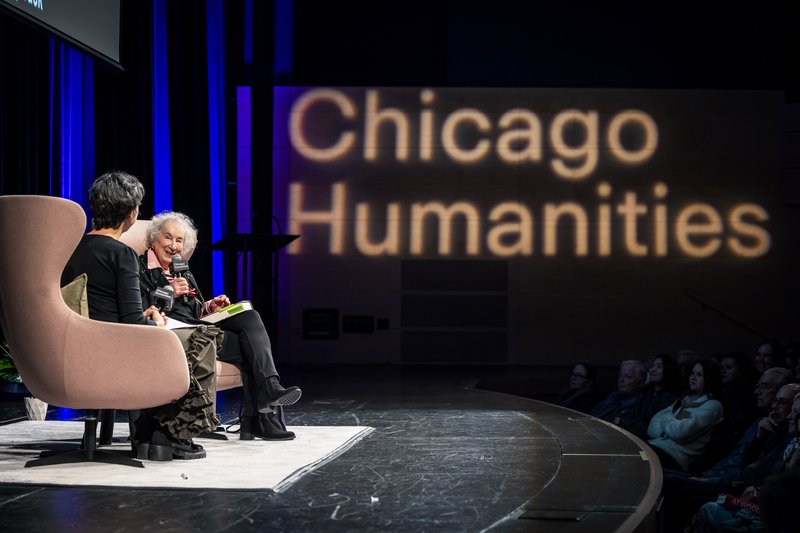
Margaret Atwood and Elif Batuman on stage speaking into handheld microphones with a Chicago Humanities logo projected behind them. Elif Batuman is seated on the left, with her face turned away from the camera, and has dark hair, a black shirt, brown dress, and black shoes. With a book sitting in her lap, Margaret Atwood is smiling. She has white hair, is wearing a pink blouse with black jacket, and black pants and boots.
Live event programmed by Michael Green
Live event produced by Nikki Konomos
Live event stage managed by Kait Samuels
Live event produced and mixed by Jeff Kolar
Production assistance by Rebecca Dose
Podcast edited and mixed by Katherine Kermgard
Voiceover by Anthony Fleming III
Transcription assistance by Micquela Washington
Become a Member
Being a member of Chicago Humanities is especially meaningful during this unprecedented and challenging time. Your support keeps CHF alive as we adapt to our new digital format, and ensures our programming is free, accessible, and open to anyone online.
Make a Donation
Member and donor support drives 100% of our free digital programming. These inspiring and vital conversations are possible because of people like you. Thank you!