Presenter Q&A: Reclaiming Chicago —Courtney Joseph on Our City's Black and Indigenous History
Chicago’s deep roots in Black and Indigenous history have been rendered largely invisible in the ubiquitous narratives of our city. Assistant Professor of History and African American Studies at Lake Forest College, Courtney Joseph is interested in another story—one that amplifies Black and Indigenous voices so as to better understand our city and country.
We asked Joseph to highlight some of the historically underappreciated people and organizations in Chicago.
JEAN BAPTISTE POINT DUSABLE
Joseph: Despite being the first non-native settler of Chicago, DuSable is an underappreciated part of Chicago’s past and present. The campaign to discredit/silence DuSable’s role in the building the foundation of Chicago is largely due to the fact that he was a Black man of Haitian descent. Yet, studying DuSable, his ancestry, his multiracial and multicultural family, and business acumen helps us to understand Chicago’s rise as the second city.
“The campaign to discredit/silence DuSable’s role in the building the foundation of Chicago is largely due to the fact that he was a Black man of Haitian descent.”
KITTIHAWA
Joseph: Kittihawa, DuSable’s wife, is also a critical yet underappreciated part of Chicago’s past. As a Pottawatomie woman, her union with DuSable was integral to his successful endeavors in Chicago. It is key that we remember and honor the indigenous parts of Illinois and Chicago’s land and culture, and remembering Kittihawa is one example of how to do so.
“It is key that we remember and honor the indigenous parts of Illinois and Chicago’s land and culture.”
ANNIE OLIVER
Joseph: Annie Oliver was the first of many Black women educators and community activists who worked to get DuSable formally recognized in the city of Chicago. Oliver helped found the National DuSable Memorial Society in the early 1930s, and her collaboration with other Black women led to the replica of DuSable’s home at the 1933 World’s Fair as well as the renaming of DuSable High School.
HAITIAN AMERICAN MUSEUM OF CHICAGO
Joseph: The Haitian American Museum of Chicago is an underappreciated part of Chicago’s present because it is the first museum dedicated to celebrating the impact of the Haitian community and culture in Chicago. Founded by Elsie Hernandez in the early 2010s, HAMOC has partnered with various organizations, like the DuSable Museum of Chicago and the DuSable Heritage Association, to uplift DuSable’s heritage in Chicago, as representative of Haiti’s impact on the city overall.
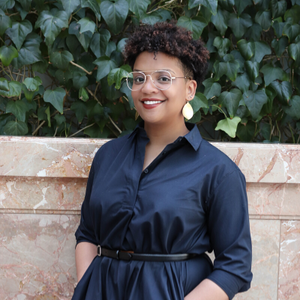
Courtney Pierre Joseph is an Assistant Professor of History and African American Studies at Lake Forest College. As part of her research, she has conducted over 60 oral history interviews with members of the Chicago Haitian diaspora. In 2018, she completed a digital project, which mapped out the Haitian churches in Chicago, and the final product is now housed by the Chicago History Museum. She is currently working on her manuscript, which is tentatively titled, DuSable’s Diaspora: Haiti, Blackness, and Belonging in Chicago, 1935-2010.
[Header image description: The banner image at the top of this media page is a graphic combining a map of Chicago with a statue of Jean Baptiste Point DuSable. The map (left) is vintage. The paper is yellowing. The words "City of Chicago" are printed at the map's top right corner. The photograph of DuSable's statue (right) depicts a bust of DuSable, wearing late 18th century garb including a jacket and cravat. DuSable looks off towards the right of the photograph.]
header image: wikimedia commons
Become a Member
Being a member of Chicago Humanities is especially meaningful during this unprecedented and challenging time. Your support keeps CHF alive as we adapt to our new digital format, and ensures our programming is free, accessible, and open to anyone online.
Make a Donation
Member and donor support drives 100% of our free digital programming. These inspiring and vital conversations are possible because of people like you. Thank you!