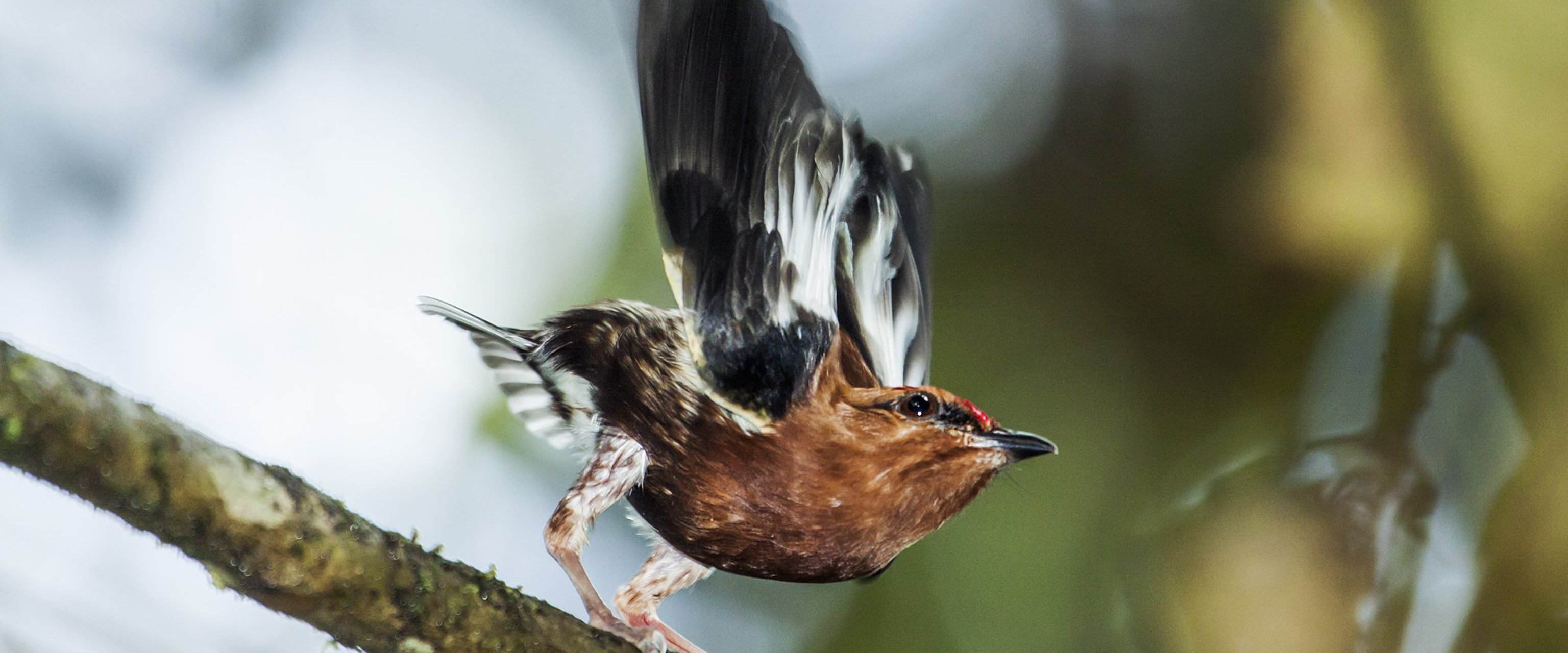
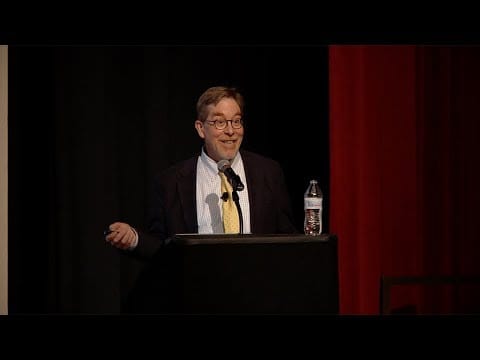
Eminent Yale ornithologist Richard Prum will change how you think about birds, sexual science, and the intersection of biology and feminism. He presented in the Belief Festival in 2017, and we talked to him about his latest research on beauty and evolution.
CHF: Can you describe avian phylogenetics and tetrahedral avian colorspace in a nutshell? Just kidding! Around the CHF office, we've been referring to you affectionately as "the bird guy." How did you come to focus on avian behavior?
Richard Prum: Don't worry, I describe myself as a "bird guy" too!
My professional interest in bird behavior grew directly out of my beginnings as a child bird-watcher. I enjoyed the challenges of finding and identifying birds, but I was also immediately fascinated by the diversity of their behavior. Having spent so much effort observing the flight styles, the foraging methods, the songs and communication behaviors of birds through birding, it was almost automatic that I would focus on bird behavior as I began to do research.
I think of birds as my muse. So, you follow where the inspiration takes you, and I have never been disappointed!
CHF: Your book The Evolution of Beauty seems to upend dominant beliefs about sexual selection. Can you outline how your findings in evolutionary biology connect to female pleasure?
RP: Evolutionary biologists have mostly focused on explaining away sexual desire as a kind of practical utility--a motivation to obtain the objectively best mate(s). Unfortunately, this view has left us without a functioning theory of the evolution of the genuine richness and complexity of sexual pleasure.
So, my view is that sexual beauty is not just an attractive, adaptive stimulus. Rather, beauty is a form of attraction that has coevolved with its evaluation. In other words, the form of desire and of the desirable have mutually shaped each other over evolutionary time. Accordingly, beauty and desire can coevolve in ways that are independent from the practical or the adaptive.
For a long time biologists have focused on the form of sexual beauty, but in the book I start to think about the other side of this coevolutionary dance–sexual pleasure. The obvious implication is that sexual pleasure–particularly female sexual pleasure–an also evolve for its own sake through female choice for more pleasurable mates. In this view, women have been the active agents in the evolution of their own sexual pleasure. It's really a whole new way to look at how sexual pleasure evolves.
CHF: You are Professor of Ornithology, Ecology, and Evolutionary Biology, but also work to foster connections across diverse scientific and humanistic disciplines. What was the most rewarding aspect of your role as Director of Franke Program in Science and the Humanities at Yale, a position you held from 2012–2017?
RP: I most loved the opportunity to bring diverse audiences together to explore new intellectual challenges! We hosted dozens of events with brilliant and passionate academics, artists, and writers, but a few really stand out. Our Extinction Studies symposium on the 100th anniversary of the Passenger Pigeon extinction was a full day of talks and discussion, that finished with a performance of a symphony written about the Passenger Pigeon in the early 19th century before it became endangered. The piece by Anthony Heinrich had never been played since its debut in the 1850s, so we were able to bring the symphony back to life after more than a century! That was a real highlight!
After stepping down, I hope to work further at the interface of science and the humanities through my own research on art and aesthetics across all disciplines–from warblers to Warhol, as I call it.
Photo Credit: Nick Athanas CC-BY-NC-SA 2.0
Become a Member
Being a member of Chicago Humanities is especially meaningful during this unprecedented and challenging time. Your support keeps CHF alive as we adapt to our new digital format, and ensures our programming is free, accessible, and open to anyone online.
Make a Donation
Member and donor support drives 100% of our free digital programming. These inspiring and vital conversations are possible because of people like you. Thank you!